The elusive magic behind a truly captivating video game isn't found just in stunning graphics or a compelling narrative. It lives deeper, in the fundamental interactions that define play itself: your Core Gameplay Mechanics & Level Design. These aren't merely components; they are the very DNA of engagement, shaping every decision, challenge, and moment of triumph a player experiences. Master them, and you unlock the secret to games people don't just play, but live and breathe.
At a Glance: Mastering Core Gameplay & Level Design
- Core Mechanics Defined: These are the essential, repeated player actions that drive the game towards its main goal. Think Mario's jump, or Doom's point-and-click gunplay.
- Identify Your Game's Heartbeat: Use tools like Essence Statements, Core Game Loop diagrams, and Noun/Verb diagrams to distill your game to its fundamental interactions.
- Less is Often More: Prioritize perfecting a few impactful mechanics over introducing many undeveloped ones. Iterate on existing ideas before adding new ones.
- Mechanics Are Not Fluff: Ensure every mechanic creates meaningful consequences and interacts widely within the game world. If it doesn't, it's probably not a mechanic.
- Levels as Playgrounds: Level design should organically challenge and showcase your core mechanics, providing diverse contexts for their use and encouraging creative problem-solving.
- Avoid Common Pitfalls: Don't confuse cosmetic differences or simple throughput changes with new mechanics. Ensure mechanics offer variety beyond basic tutorials.
The DNA of Fun: What Are Core Gameplay Mechanics?
At the heart of every great game lies a set of core mechanics – the repeated actions a player takes while striving to achieve the game's overall objective. These aren't just any actions; they are the fundamental interactions that give the game its identity and define how players engage with its world. As defined in "Game Design Workshop," it's "what the player does most often while striving to achieve the game's overall goal."
Consider Super Mario Bros.: jumping is the undisputed core mechanic. Every level, every enemy, every power-up revolves around this singular action. In Call of Duty, it's the precise "point-and-click" gunplay. These actions aren't mere features; they are the bedrock upon which the entire player experience is built.
Identifying your core mechanics early in development isn't just an academic exercise; it's a strategic imperative. It sharpens your design focus, helps you fiercely fight off "feature creep" (that insidious tendency to add too many unnecessary elements), and ultimately deepens your understanding of what players will actually do in your game. This clarity ensures that development resources are invested wisely, building out the elements that truly matter.
Dissecting Gameplay: Mechanics Versus Other Game Elements
In game design, terminology can get murky. To truly understand core mechanics, it's vital to distinguish them from other closely related, but distinct, game elements. Confusing these terms can lead to misdirected development efforts and ultimately, a less cohesive game.
Game Mechanics vs. Gameplay
- Game Mechanics: These are the specific, foundational interactions defined by the designer. Think of them as the rules and systems that dictate how things work – the physics of a jump, the targeting system of a gun, the rules for placing a block. They are the implementable components.
- Gameplay: This is the broader term encompassing how a player experiences the game through these mechanics. It includes dynamics, features, and the emergent patterns that arise. Gameplay is the act of using a jump to clear a chasm, aiming to defeat an enemy, or strategizing block placement to clear a line. It's the player's journey using the tools (mechanics) provided.
Game Mechanics vs. Game Features
- Game Mechanics: As discussed, these are the fundamental player/world interactions.
- Game Features: These are broader aspects used to describe or market a game. "Multiplayer mode," "a compelling story," "skill trees," or "procedural generation" are features. While they might contain mechanics (e.g., skill trees modify character abilities, which are mechanics), the feature itself is a high-level descriptor of an experience, not a specific interaction.
Game Mechanics vs. Game Rules
- Game Mechanics: These define how interactions occur within the game world.
- Game Rules: These are the explicit instructions or constraints players must follow. Rules provide structure, fairness, and define win/lose conditions. "You win if you collect 10 stars," or "You lose if your health reaches zero," are rules that dictate how mechanics (like collecting or combat) are applied within a given framework.
Game Mechanics vs. Game Design
- Game Mechanics: These are interactive elements that enable player-world interaction.
- Game Design: This is the overarching discipline of planning and integrating all game elements – mechanics, level design, narrative, art, balance, sound – to craft the overall vision and player experience. Mechanics are a critical subset of game design.
What Isn't a Mechanic (On Its Own)?
A common misconception is that every element of a game is a mechanic. Not so. A true mechanic creates consequences in the game world. If an element doesn't impact player interaction or change the game state meaningfully, it's often "fluff."
For example:
- Money or Tokens: These aren't mechanics themselves, but rather representations of a mechanic. The mechanic is "spending money to upgrade" or "collecting tokens to unlock."
- Animations or Art: These are visual feedback, not mechanics. The mechanic is the action the animation represents (e.g., attacking).
- Buttons: A button is an input device. The mechanic is the action tied to the button (e.g., pressing X to jump).
- Dice: Dice themselves aren't mechanics. They are an expression of uncertainty that adds variance to a mechanic's result. The mechanic might be "roll to attack," with the dice determining the outcome.
- Cinematics or Sounds: These enhance immersion and feedback but are not interactive mechanics.
To be a robust mechanic, it must interact with a wide variety of situations or fundamentally shape how the game is played. Otherwise, you're likely investing resources into elements that don't deeply enrich the gameplay.
Finding Your Game's Heartbeat: Identifying Core Mechanics
Before you can refine or expand your game's mechanics, you need to clearly define them. Several powerful tools can help you cut through the noise and identify the true essence of your player's experience.
1. The Essence Statement: Your Game's Elevator Pitch
Imagine you have just one to two sentences to describe what your game is about, specifically focusing on what the player does. That's your Essence Statement. It's a succinct declaration of the player’s goal, the primary actions they can take (verbs), and their role in the game.
- Example (Pac-Man): "As Pac-Man, the player eats all the dots in a maze while avoiding ghosts and occasionally eating power pellets to turn the tables and hunt the ghosts."
- Key Focus: Concentrate on the verbs and the player's goal. Leave out art style, story elements, or specific settings for now.
- Actionable Insight: Draft your game's Essence Statement. Does it clearly convey the player's objective, their primary actions, and their role? Does it accidentally include mechanics you hadn't considered? Review and incorporate them or question their necessity.
2. The Core Game Loop Diagram: Visualizing the Flow
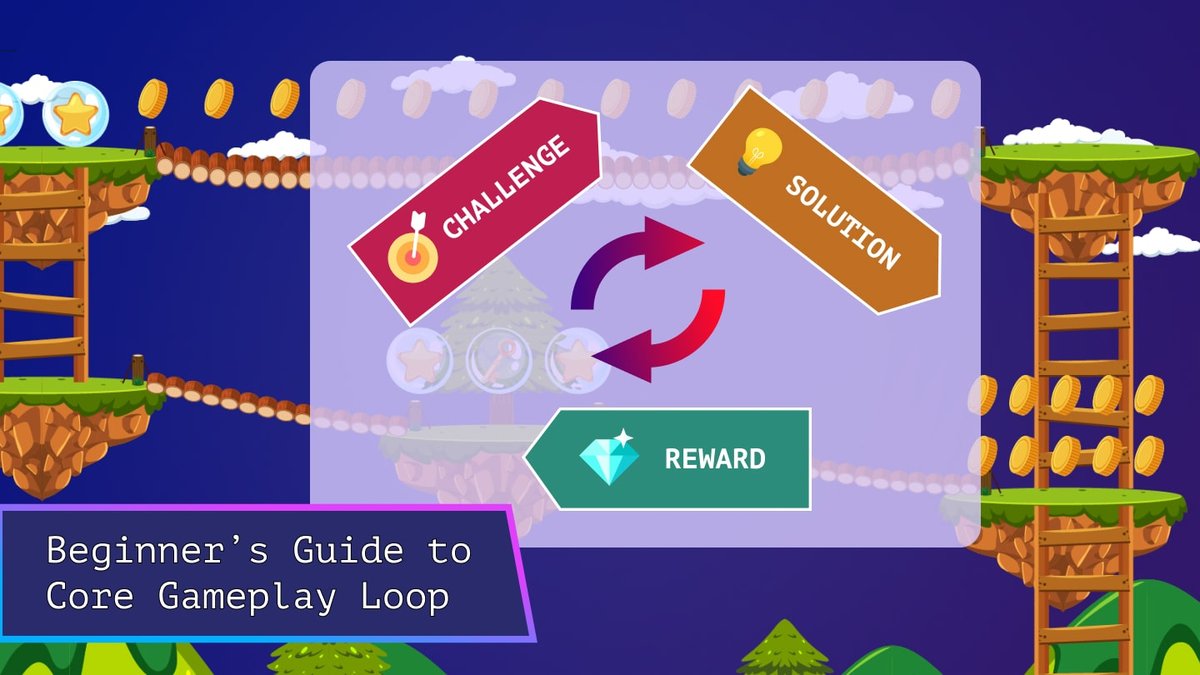
Once you have your Essence Statement, the Core Game Loop provides a visual blueprint. This diagram illustrates the series of actions players repeat most often. It’s a cyclical representation of "what the player does, what happens next, and what they do after that."
- Purpose: The loop focuses your design, ensuring all core mechanics serve a clear, repeatable cycle. If a mechanic doesn't fit into this loop or support the Essence Statement, it's a prime candidate for reconsideration or removal.
- Pac-Man Example:
- Eat Dots (Progress)
- Avoid Ghosts (Challenge)
- Find Power Pellet (Opportunity)
- Eat Ghosts (Reward/Temporary Power)
- Return to Eating Dots (Repeat)
- Sub-Loops: Core loops can contain smaller, secondary loops (e.g., in Pac-Man, eating fruit might be a score sub-loop, not directly tied to level progression).
- Actionable Insight: Sketch out your game's core loop. Try to simplify it, reducing the number of "bubbles" or steps without altering the fundamental experience. Ensure every element directly supports your Essence Statement. Understanding player motivation can provide further insights here, as a strong loop taps into intrinsic desires.
3. The Noun/Verb Diagram: Mapping Interactions
This diagram helps visualize relationships between important objects (nouns) and the actions (verbs) players or other entities perform. It's particularly useful for identifying major mechanics when they're not immediately obvious.
- Steps:
- List Major Nouns: Identify all significant objects in your game (e.g., Player, Enemy, Health Pack, Door, Key). Exclude purely code-driven elements.
- Draw Connections with Verbs: Draw lines between nouns and label them with verbs describing their interactions.
Player --Attacks--> EnemyEnemy --Damages--> PlayerPlayer --Collects--> Health PackPlayer --Uses--> KeyKey --Unlocks--> Door- Player Focus: The player should typically have the most verbs associated with them. If another object does, it might indicate a design where player agency is diluted, and focus needs to shift back.
- Actionable Insight: Create a Noun/Verb diagram for your game. Does it align with your Essence Statement? Are there too many verbs for non-player entities, suggesting a need to re-center player action?
Refining Your Vision: Editing and Focusing Core Mechanics
Identifying your core mechanics is just the first step. The true craft lies in refining and focusing them. It's easy to get excited about new ideas and pile on more features, but a truly great game often comes from perfecting a few key interactions.
Shigeru Miyamoto, the legendary creator of Mario, famously articulated this principle: "That's how we make games at Nintendo... we had the fundamentals solid first, then do as much with that core concept as our time and ambition will allow." Mario 64, for instance, didn't introduce a dozen new mechanics; it iterated endlessly on the core jumping mechanic, exploring every possible nuance and application.
- Ruthless Prioritization: If your identification exercises (Essence Statement, Core Loop, Noun/Verb) felt difficult, or if some mechanics didn't quite fit, it's a sign to rethink. Ask yourself: Does every identified mechanic reinforce the core experience, or does it distract from it? Be prepared to cut anything that doesn't fit.
- Iterate, Don't Just Add: It's almost always better to deeply explore and perfect one core mechanic than to have several underdeveloped ones. If your game feels "lean," resist the urge to introduce entirely new mechanics. Instead, find ways to make your existing ones more versatile, challenging, or satisfying. How can you add depth to the jump, the shoot, the block placement?
- The Power of Simplicity: A game with a strong, simple core can often offer immense depth. Think of Tetris: one core mechanic (rotating and placing blocks), yet endless strategic possibilities. Prioritize mastering that foundational interaction before venturing into complex additions. For more on this, consider the principles of iterative design for game mechanics.
Layers of Interaction: Core, Primary, and Secondary Mechanics
Not all mechanics are created equal. They exist in a hierarchy, each playing a distinct role in the overall game experience.
- Core Mechanic: This is the absolute foundation, the emotional drive of your game. Without it, the game fundamentally changes or ceases to exist. (e.g., Jump in Mario, Point-and-click gunplay in Call of Duty, Portal creation in Portal).
- Primary Mechanics: These directly support and interact with the core mechanic. They often enhance or modify the core action. (e.g., Wall-sliding in Mario to extend a jump, Weapon reloading in Call of Duty, Picking up objects with portals in Portal). The game might still function without them, but it would feel less rich or complete.
- Secondary Mechanics: These add depth, flavor, and variety. They are often optional and can be removed without collapsing the entire game structure. (e.g., Fire flowers in Mario, Grenades in Call of Duty, Turrets in Portal). While valuable for adding strategic options and replayability, introducing too many secondary mechanics without careful integration can lead to "complexity creep," overwhelming players and diluting the core fun.
A key aspect of sophisticated design is varying the core mechanic itself. The Portal gun, for instance, isn't just one mechanic; it evolves. Initially, it's about creating portals. Later, it's about manipulating physics, redirecting energy, and solving complex environmental puzzles – all stemming from that single, powerful tool. Secondary mechanics, in contrast, are usually simpler and less interwoven with other systems.
Level Design: The Canvas for Your Mechanics
Core gameplay mechanics and level design are inextricably linked; one cannot truly thrive without the other. Levels are not just environments; they are curated spaces designed to challenge, teach, and celebrate your mechanics. A brilliant mechanic can fall flat in poorly designed levels, just as stunning visuals can't save a game with weak core interactions.
Effective level design provides context for your mechanics, ensuring they have meaningful impact and are regularly tested in diverse scenarios.
Creating Satisfying Mechanics Through Context
- Scattered Challenges: Don't just introduce a mechanic and forget about it. Design specific challenges throughout the game that require players to use it. Gradually increase the complexity of these challenges.
- Revisiting with New Tools: A powerful technique is allowing players to revisit old objectives or areas with new mechanics, offering fresh ways to solve familiar problems. This rewards skill development and encourages creative thinking.
- The Context Questionnaire: When designing a mechanic or a level, ask yourself these questions to ensure meaningful integration:
- Enemies: How does this mechanic change how players interact with enemies? How can enemies disrupt its use, forcing adaptation? Is it useful frequently, but not constantly, ensuring strategic deployment?
- Friends/Other Players: Does the mechanic foster observation, coordination, or creativity when interacting with friendly units or other players (in multiplayer)?
- Environment: How does the world respond to this mechanic? What elements don't react, and is this clearly communicated to the player? Can the mechanic be enabled or disabled in certain areas to vary challenges, adding depth to level design?
By thoughtfully designing levels around your mechanics, you create a feedback loop where players continuously learn, apply, and master the tools you've given them, leading to a much more engaging experience. This is crucial for keeping players hooked, much like the precision platforming in Our Sonic X Shadow Generations review demands mastery of speed and movement mechanics.
Genre Expectations: Mechanics in Action
Different game genres cultivate distinct sets of core mechanics, driven by the unique goals and experiences they promise players. Understanding these genre conventions is crucial for meeting player expectations and designing effective mechanics.
- Role-Playing Games (RPGs): The core here often revolves around growth, progression, and overcoming adversity through character development.
- Elements: Power growth (XP, levels, stats), acquiring new abilities, forgiving failure tolerance (generous respawn), complex equipment and inventory systems.
- First-Person Shooters (FPSs): FPS games are built on aim-and-click mechanics, dexterity, and reaction speed.
- Elements: Varied gunplay (aiming, trajectory, weapon types), diverse respawn mechanics (timed, wave-based, permadeath), collection systems for weapons, health, and armor.
- Board Games: These prioritize measurable victory conditions, strategic resource management, and social interaction.
- Elements: Clear win/lose states, catch-up mechanics, resource generation and expenditure, rules that can be created or broken, and mechanics that encourage deception or persuasion.
- Simulation Games: The emphasis in simulations is on self-directed exploration, expression, and improvement through learning.
- Elements: Customization options, robust trial-and-error loops, intrinsic goal-setting (players define their fun), and often gamified systems for resource management or skill acquisition.
By understanding the established mechanic patterns within your chosen genre, you can better innovate while respecting player expectations.
Common Pitfalls: Mechanics That Miss the Mark
Even experienced designers can fall into traps when conceptualizing and implementing game mechanics. Avoiding these common mistakes can save significant development time and prevent player frustration.
1. Contextualization Is Not the Mechanic
A common error is confusing cosmetic descriptions or simple number changes with entirely new mechanics. For instance, a "flaming sword" isn't a new mechanic if it simply deals more damage than a regular sword. The mechanic is "attacking for damage." A flaming sword becomes a new mechanic only if it introduces a unique interaction, like "dealing fire damage that ignites enemies and spreads," or "bypassing certain elemental resistances."
- Correction: Focus on unique interactions and consequences that change how the player thinks or acts. If the core interaction is identical, it's not a new mechanic, it's just a variant.
2. Tutorialization Is Not Rich Gameplay
If a mechanic is repeatedly taught or forced through the same single solution, it creates frustration rather than engagement. A core mechanic needs variety and opportunities for players to grow, experiment, and innovate beyond the initial "how-to." A simple jump mechanic is rich if it can be used for platforming, dodging, triggering environmental elements, or reaching hidden areas – not if it's only ever used to clear the exact same 5-foot gap 50 times.
- Correction: Design challenges that require creative application of mechanics, offering multiple solutions or emergent strategies. The psychology behind compelling game challenges emphasizes the importance of varied problem-solving.
3. Throughput Is Not a Mechanic
Another pitfall is mistaking different damage numbers or attack rates for distinct mechanics. If a fast saber and a heavy hammer both perform the same "attack for damage" action, just with different numerical outcomes, they aren't mechanically distinct. They are merely different throughput values.
- Correction: True mechanics design involves giving weapons or abilities different ways of interacting with the world. A hammer might shatter shields (a unique interaction), while a saber might parry attacks (another unique interaction). These are different mechanics because they introduce distinct actions and consequences beyond just damage numbers.
Building Beyond the Blueprint: The Iterative Cycle of Engagement
Crafting compelling core gameplay mechanics and designing levels that celebrate them isn't a one-time task; it's a continuous, iterative process. The journey from initial concept to a truly engaging player experience demands clarity, focus, and a relentless commitment to refinement.
By diligently identifying your core mechanics using tools like Essence Statements, Core Game Loops, and Noun/Verb diagrams, you lay a solid foundation. Distinguishing true mechanics from mere features or fluff ensures that your development efforts are precisely targeted. And understanding the hierarchy of core, primary, and secondary mechanics helps you build depth without succumbing to complexity creep.
Ultimately, your levels are the stages where these mechanics come alive. They provide the context, the challenges, and the opportunities for players to master the interactions you've so carefully designed. By avoiding common pitfalls and constantly seeking feedback, you can ensure that every mechanic you implement leads to meaningful consequences and fosters genuine player engagement. This is the art of giving players the tools to tell their own stories within your game world, ensuring they don't just play, but truly experience the game you've poured your heart into.